Step Into the Future: Virtual, Augmented & Beyond
Introduction:-
Step into a world where the boundaries between the physical and digital dissolve. With the rise of virtual reality (VR), augmented reality (AR), mixed reality (MR), and extended reality (XR), our perceptions and experiences are being transformed like never before. These cutting-edge technologies are not just reshaping entertainment and gaming—they’re revolutionizing how we learn, connect, and interact with the world around us. In this blog, we’ll explore how these immersive realities are redefining what’s possible and opening the door to a truly limitless future.
Today, four distinct immersive realities are shaping our digital landscape.
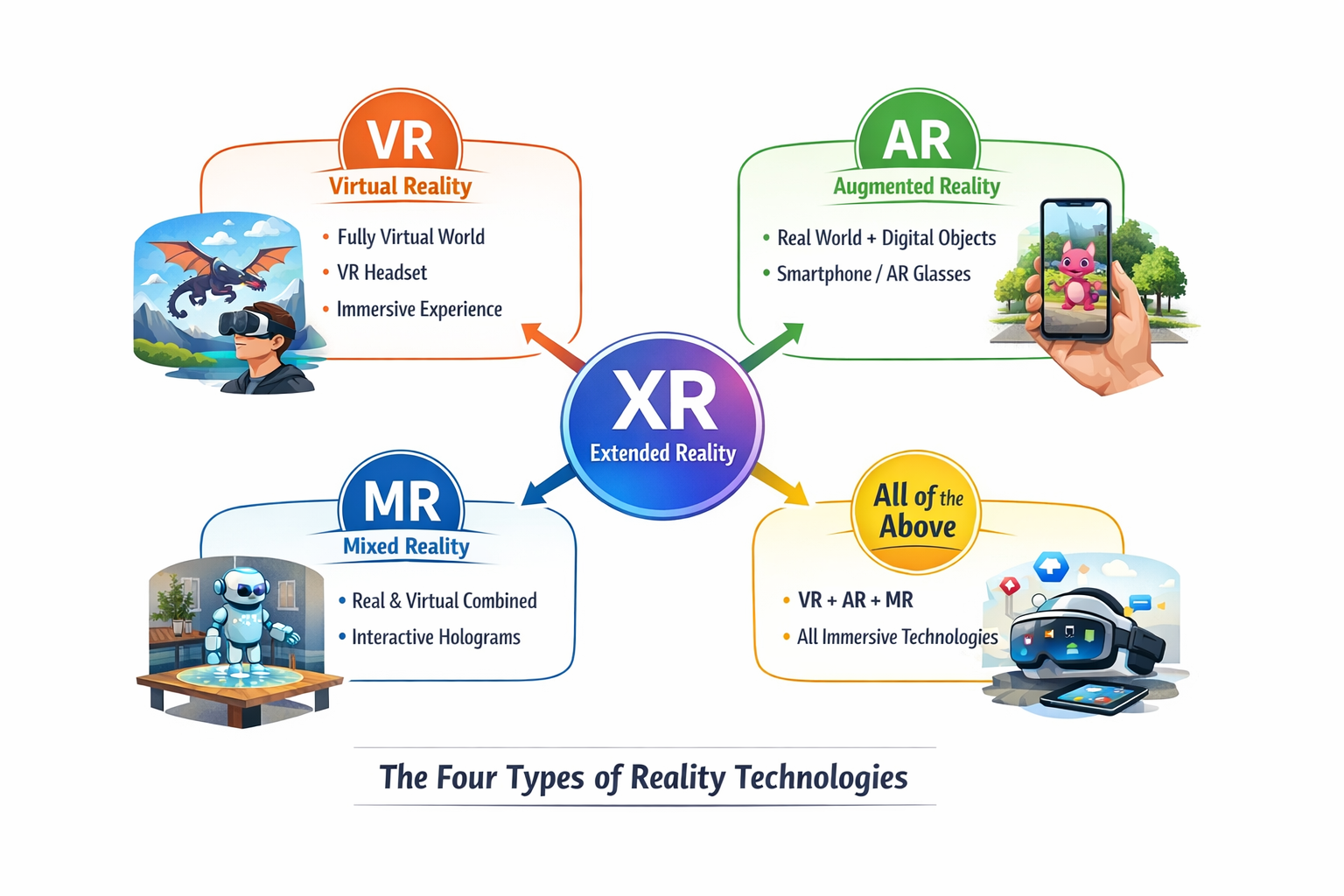
(i) Virtual Reality:- Virtual Reality (VR) is an advanced technology that creates a fully immersive, computer-generated environment that allows users to experience and interact with a virtual world as if they were physically present in it. Unlike traditional screens, VR uses special devices such as VR headsets, motion sensors, and handheld controllers to simulate a realistic environment. When a user wears a VR headset, the real world is blocked out and replaced with a 3D digital environment that responds to the user’s movements. For example, when the user turns their head or moves their hands, the virtual environment changes accordingly, creating a feeling of actually being inside that digital space. One of the main features of Virtual Reality is immersion, which means the user feels completely surrounded by the virtual environment. Another important feature is interaction, allowing users to interact with virtual objects using controllers or hand tracking. VR also includes real-time simulation, meaning the virtual world updates instantly in response to the user’s actions. Additionally, VR provides 360-degree visualization, giving users the ability to look in any direction within the virtual environment. Virtual Reality has numerous applications in various fields, including gaming, education, medical training, engineering, military simulations, virtual tourism, and entertainment.
For example, pilots can train using VR flight simulators, doctors can practice complex surgeries, and students can explore historical places virtually. Because of these capabilities, Virtual Reality is considered one of the most innovative technologies that is transforming how people learn, work, and experience digital environments.
(ii) Augmented Reality:- Augmented Reality (AR) is a technology that enhances the real world by adding digital elements such as images, animations, sounds, or information on top of the physical environment. Unlike Virtual Reality, which completely replaces the real world, Augmented Reality allows users to see the real environment while interacting with virtual objects at the same time. AR usually works through devices such as smartphones, tablets, AR glasses, or special headsets that use cameras and sensors to detect the surroundings and place digital content in the correct position. When a user points their device at a particular object or location, the AR system overlays computer-generated graphics or information on the screen, making the experience interactive and informative. One of the main features of Augmented Reality is real-world integration, where digital objects appear as if they exist in the physical world. Another important feature is real-time interaction, which means the digital content changes instantly based on the user’s movement or the environment. AR also provides 3D visualization, allowing users to view virtual objects from different angles. In addition, it supports object recognition and tracking, enabling the system to identify surfaces, images, or locations to place digital elements accurately. Augmented Reality is widely used in education, gaming, shopping, navigation, healthcare, and marketing.
For example, students can see 3D models of planets in AR learning apps, customers can visualize furniture in their homes before buying it, and games can display virtual characters in real-world locations. Because of its ability to combine digital content with the real environment, Augmented Reality is becoming an important technology that improves how people learn, explore, and interact with information in everyday life.
(iii) Mixed Reality:- Mixed Reality (MR) is an advanced technology that combines elements of both Virtual Reality (VR) and Augmented Reality (AR) to create an environment where real-world and digital objects exist and interact with each other in real time. In Mixed Reality, users can see the real world around them while also interacting with virtual objects that appear as if they are part of the physical environment. This technology uses devices such as MR headsets, smart glasses, sensors, and cameras to understand the user’s surroundings and accurately place digital objects within that space. Unlike Augmented Reality, where digital objects are simply overlaid on the real world, Mixed Reality allows those objects to respond to the physical environment and user actions, making the experience more interactive and realistic. One of the key features of Mixed Reality is environment mapping, where the system scans and understands the physical space to place virtual objects correctly. Another important feature is real-time interaction, allowing users to move, rotate, or manipulate virtual objects using hand gestures, controllers, or voice commands. Mixed Reality also provides spatial awareness, meaning digital objects can interact with real surfaces such as walls, tables, or floors. Additionally, MR offers 3D visualization and immersive experiences, making digital content appear as realistic as possible. Mixed Reality is widely used in fields such as education, healthcare, engineering, architecture, product design, and training simulations.
For example, engineers can view and modify 3D models of machines in real space, doctors can study detailed 3D models of the human body, and students can explore complex concepts through interactive holograms. Because of its ability to blend the physical and digital worlds seamlessly, Mixed Reality is considered one of the most innovative technologies that is transforming the way people work, learn, and interact with digital information.
(iv) Extended Reality:- Extended Reality (XR) is a broad term used to describe all immersive technologies that combine the physical world with digital environments. It serves as an umbrella concept that includes Virtual Reality (VR), Augmented Reality (AR), and Mixed Reality (MR). XR technologies are designed to enhance or completely transform the way people experience and interact with digital content by creating immersive environments that feel more natural and engaging than traditional computer screens. These technologies use devices such as VR headsets, AR glasses, sensors, cameras, and motion controllers to detect user movements and surroundings, allowing digital elements to respond in real time. One of the main features of Extended Reality is immersion, which enables users to feel deeply involved in a digital or mixed environment. Another key feature is interaction, where users can manipulate virtual objects through gestures, voice commands, or controllers. XR also provides real-time simulation and 3D visualization, making digital environments more realistic and dynamic. Additionally, XR systems often include spatial tracking and environment understanding, allowing virtual objects to be placed accurately in physical spaces. Extended Reality is widely used in various industries such as education, healthcare, gaming, entertainment, engineering, training, retail, and virtual tourism.
For example, students can explore virtual laboratories, doctors can practice medical procedures safely, companies can train employees using realistic simulations, and customers can experience products virtually before purchasing them. Because it integrates multiple immersive technologies into a single concept, Extended Reality is considered an important innovation that is shaping the future of digital interaction, learning, and communication.
Let’s dive into some fascinating facts about these four immersive realities.
🔹 Facts about Virtual Reality (VR)
- VR creates a fully immersive digital environment where users cannot see the real world.
- The first VR headset prototype was developed in 1968 by Ivan Sutherland, called the Sword of Damocles.
- VR is widely used in gaming, military training, flight simulation, and medical training.
- Many universities use VR to create virtual laboratories and classrooms.
- VR can reduce training costs because people can practice in a simulated environment instead of real situations.
🔹 Facts about Augmented Reality (AR)
- AR adds digital content to the real world instead of replacing it.
- The popular mobile game Pokémon Go made AR technology widely known around the world.
- AR is used in shopping apps to let customers see how furniture, clothes, or makeup will look before buying.
- Many educational apps use AR to show 3D models of planets, animals, and the human body.
- AR is also used in navigation systems that display directions on the real road view.
🔹 Facts about Mixed Reality (MR)
- MR combines real and virtual worlds where both can interact with each other.
- In MR, digital objects can stay fixed to real surfaces like walls or tables.
- It is used in engineering, architecture, and product design to visualize models in real space.
- MR helps doctors study 3D models of organs for better surgical planning.
- MR devices use advanced sensors and cameras to understand the physical environment.
🔹 Facts about Extended Reality (XR)
- XR is an umbrella term that includes VR, AR, and MR technologies.
- XR is expected to play a big role in the future of education, remote work, and training.
- Many companies are investing billions in XR to build the next generation of digital experiences.
- XR can be used to create virtual meetings where people feel like they are in the same room.
- The XR market is growing rapidly and is predicted to become a multi-billion-dollar industry in the coming years.
In conclusion, virtual reality, augmented reality, mixed reality, and extended reality are not just buzzwords—they represent a fundamental shift in how we perceive and interact with the world. As these technologies continue to advance, they promise to revolutionize industries, enhance our daily experiences, and unlock creative possibilities we’ve only begun to imagine. Embracing these immersive realities means stepping boldly into the future, where the boundaries between the physical and digital are limited only by our imagination.
Comments
Post a Comment